


Commercial Cleaning vs Janitorial Services: Which Fits Your Facility
Last Updated: November 5, 2026
Quick Summary
Commercial cleaning is the broader category of professional facility care, while janitorial services are the routine, day-to-day tasks within it, such as trash removal, restroom cleaning, dusting, mopping, and wiping high-touch surfaces. Janitorial work maintains a baseline; commercial cleaning resets and restores it with periodic and specialized jobs.
Janitorial tasks run daily or weekly, while commercial cleaning adds monthly, quarterly, or on-demand jobs.
Carpet extraction is typically scheduled quarterly to yearly, and floor stripping and waxing one to two times per year.
Build your janitorial checklist around rooms, not tasks, and verify it with randomized inspections.
Contracts commonly exclude floor stripping, carpet extraction, and window exteriors above the first floor.
Compare bids at the same frequency and task list, since a lower monthly number may exclude floor care.
Table of Contents
Commercial Cleaning vs Janitorial Services: The Core Difference
Commercial cleaning is the broader category of professional facility care, covering everything from nightly office upkeep to heavy periodic work like carpet extraction and post-construction cleanup. Janitorial services are the routine, day-to-day tasks inside that category: trash removal, restroom cleaning, dusting, mopping, and wiping high-touch surfaces.
Confusing the two costs facility managers money. Facilities sometimes pay for heavy deep cleaning they don't need, or sign a janitorial contract that never covers floor care and then wonder why the floors look dull.
Below, we break down where each service starts and stops, how to schedule both, and how to read a contract before you sign it.
What Commercial Cleaning Covers
Commercial cleaning covers the full scope of keeping a commercial facility clean, safe, and presentable. It includes routine janitorial work plus the heavier, periodic, and specialized tasks that fall outside a nightly routine.
That means:
Deep cleaning of carpets, upholstery, and hard floors
High-pressure and specialized surface cleaning
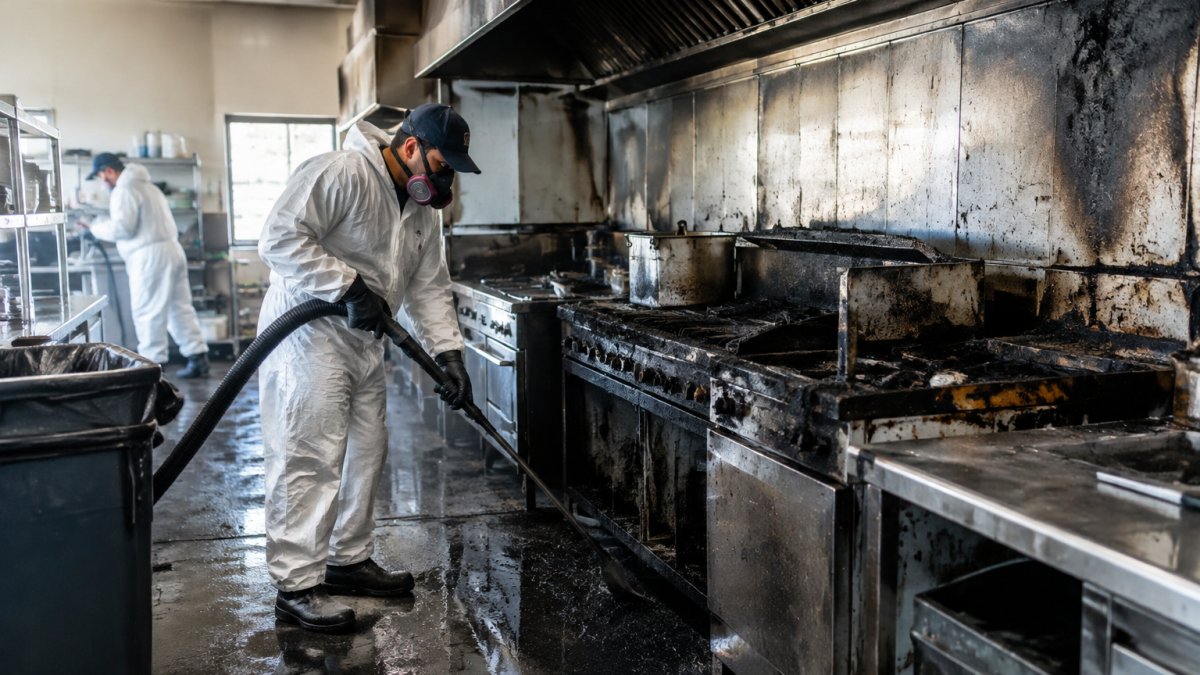
Post-construction and one-time cleaning
Disinfection and pathogen eradication
Exterior and window cleaning
The U.S. Occupational Safety and Health Administration guidance on workplace cleanliness treats workplace cleanliness as a safety issue, not just an appearance one. That framing matters: commercial cleaning is the umbrella, and janitorial work sits underneath it.
What Janitorial Services Cover
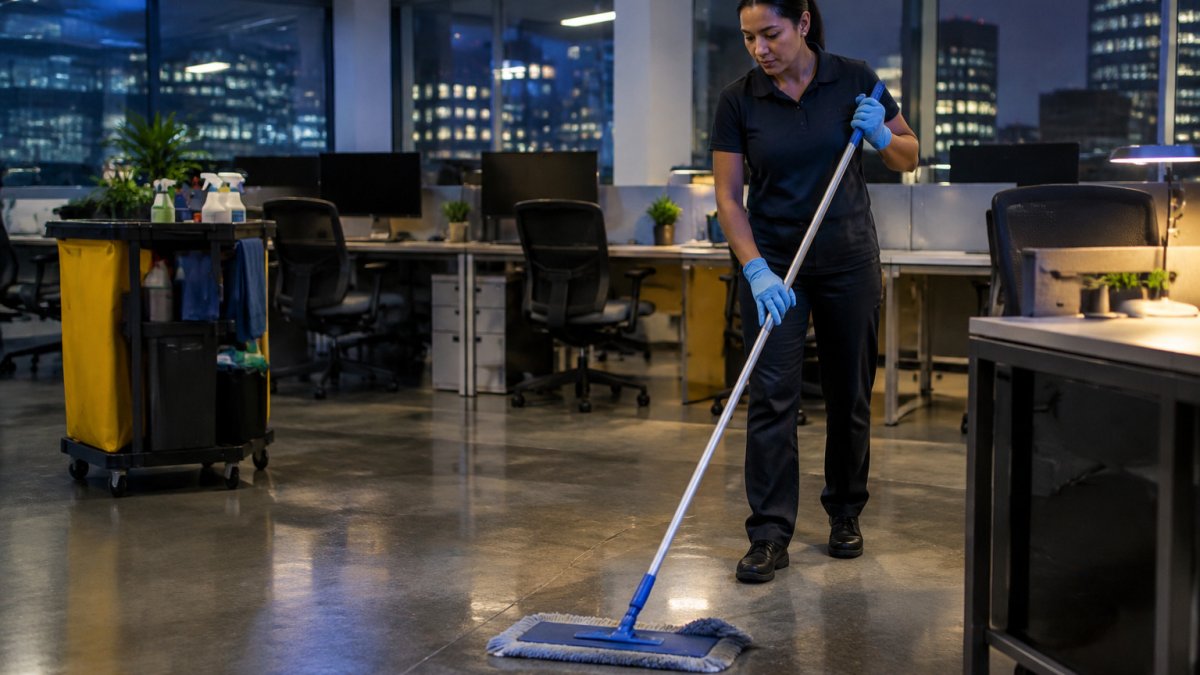
Janitorial services are the recurring, day-to-day cleaning tasks that keep a facility running. They happen on a set schedule, usually nightly or several times a week, and follow a checklist.
Typical janitorial tasks include:
Trash removal and liner replacement
Restroom cleaning and restocking
Dusting, mopping, and vacuuming
Wiping high-touch surfaces like door handles and light switches
Breakroom and common-area cleaning
Janitorial work is about consistency, not depth. A janitorial crew keeps a facility at a baseline standard every single day. For a closer look at what a full service offering includes, see our commercial cleaning services.
Side-by-Side Comparison: Tasks, Frequency, and Scope
The clearest way to separate the two is a task and frequency matrix. Janitorial work runs daily or weekly; commercial cleaning adds the periodic and specialized jobs that run monthly, quarterly, or on demand.

Task | Service Type | Typical Frequency |
Trash removal | Janitorial | Daily |
Restroom cleaning | Janitorial | Daily |
Dusting and surface wiping | Janitorial | Daily to weekly |
Mopping and vacuuming | Janitorial | Daily to weekly |
Carpet extraction | Commercial | Quarterly to yearly |
Floor stripping and waxing | Commercial | 1-2 times per year |
Deep disinfection | Commercial | On demand |
Post-construction cleanup | Commercial | One-time |
The takeaway: janitorial services maintain a baseline. Commercial cleaning resets and restores it.
Building a Commercial Cleaning Schedule That Works
A commercial cleaning schedule that works matches task frequency to how fast a space gets dirty. High-traffic restrooms and lobbies need daily attention; private offices and storage areas can go longer.
Start by mapping your facility into zones. Assign each zone a frequency based on foot traffic and risk, then build the schedule around those zones rather than a single blanket routine. Healthcare facilities, schools, and warehouses each need different rhythms.
The mistake we see most often: facilities set a schedule once and never revisit it. Traffic patterns change, seasons change, and a schedule that worked in January can leave restrooms short-staffed in July. Our guide to commercial cleaning service consistency tips covers how to keep results steady once the schedule is set.
The Janitorial Services Checklist Every Facility Manager Needs
A janitorial services checklist turns a vague standard into pass-or-fail tasks. Without one, "clean" means whatever the crew decides it means that night.
Build your checklist around rooms, not tasks. For each room, list what must be done and what "done" looks like:
Restrooms: fixtures disinfected, mirrors streak-free, supplies restocked
Breakroom: counters wiped, appliances exterior-cleaned, trash emptied
Lobby: floors mopped, glass cleaned, entry mats vacuumed
Offices: trash removed, desks dusted (clear surfaces only), floors vacuumed
Hallways: high-touch surfaces wiped, floors swept and mopped
Then verify it. A checklist nobody inspects is a wish list. Our guide to verifying cleaning consistency in commercial facilities explains how to run randomized inspections and log missed tasks before they become a pattern.
How to Read a Janitorial Services Contract Before You Sign
A janitorial services contract should spell out scope, schedule, staffing, and what happens when something goes wrong. If any of those four is vague, you will be the one absorbing the cost.
Read for these clauses:
Scope of services: the exact task list, by room and frequency. "General cleaning" is not a scope. A usable scope reads like "Restrooms 101-108: fixtures disinfected, mirrors wiped, supplies restocked, floors mopped, five nights per week."
Service schedule: days, times, and blackout periods. Confirm whether the crew works after hours or during business hours, and who unlocks the building.
Staffing: who cleans your facility, whether the same crew returns each visit, whether background checks are required, and whether substitutes are allowed without notice.
Service-level agreement: the measurable standard and the remedy. Look for an inspection frequency, a task-completion threshold, a response time for complaints, and a re-cleaning window.
Price adjustment and termination: how rates change at renewal, notice periods, and exit terms.
A service-level agreement is only as strong as its remedies. A common pattern is an SLA that promises a response "within a reasonable time" with no defined window and no credit for repeat misses.
Watch out: a contract that lists "general cleaning" without a task list gives the provider room to interpret scope in their favor.
Also check exclusions. Contracts commonly exclude floor stripping and waxing, carpet extraction, window exteriors above the first floor, and post-construction debris.
Finally, confirm insurance and compliance terms: general liability coverage, workers' compensation, bonding for staff with keys, and chemical safety documentation.
Getting an Accurate Office Cleaning Estimate
An accurate office cleaning estimate comes from a walkthrough, not a phone call. Square footage alone does not tell a provider how many restrooms, how much floor care, or how many high-touch surfaces a facility has.
Expect the estimator to ask about:
Facility size and layout, including restrooms and breakrooms
Traffic volume and operating hours
Floor types and current condition
Any specialized areas, like food prep or clinical space
Frequency and scope you need
Those questions map to four cost drivers. Understanding them lets you see why two quotes for the same square footage can differ sharply:
Labor hours. Cleaning is priced mostly on time, and time is driven by restroom count, square footage of hard floor versus carpet, and how many surfaces need wiping. A building with ten restrooms costs more to service than one with two, even at identical square footage.
Frequency. Nightly service costs more per month than three visits per week, but the per-visit rate often drops as frequency rises because travel and setup are spread across more visits. Compare quotes at the same frequency, or the comparison is meaningless.
Scope mix. Routine janitorial tasks and periodic commercial tasks are usually priced differently. Carpet extraction, floor stripping and waxing, and deep disinfection are often quoted per event rather than folded into the monthly rate. Ask which tasks are in the recurring price and which are billed on demand.
Specialized work. Clinical space, food-prep areas, and post-construction cleanup carry additional labor, equipment, and chemical requirements. These are the tasks most likely to be subcontracted, which adds a layer of accountability you should ask about.
A practical way to compare bids is to request a line-item breakdown: monthly recurring labor, supplies, periodic floor care priced separately, and any on-call rates. Then normalize every bid to the same frequency and the same task list before comparing totals.
Pricing depends on labor hours, facility size, and scope, so we do not quote blind. For a step-by-step walkthrough of the request process, see how to get a quote for janitorial services. The U.S. Small Business Administration's guidance on comparing vendor bids is a useful primer on evaluating competing proposals.
Watch out: a quote built only on square footage, with no walkthrough and no task list, will almost always be revised upward once the crew sees the restrooms and the floor condition. Treat any phone-only number as a placeholder, not a budget.
When to Combine Routine Janitorial Work With Specialized Cleaning
Combining routine janitorial work with specialized cleaning makes sense when one provider can handle both without subcontracting the hard parts. That keeps accountability in one place.
Combine services when your facility has:
Clinical or food-safety zones that need disinfection beyond routine wiping
Flooring that needs periodic extraction or stripping
A need for fast response to outbreaks or emergencies
The Centers for Disease Control and Prevention guidance on cleaning and disinfecting facilities draws a clear line between cleaning and disinfecting. A janitorial crew that only cleans will not meet a disinfection standard on its own. That gap is where a specialized provider earns its place.
Request a Walkthrough and Quote From CVG Specialized Cleaning INC
The fastest way to settle commercial cleaning vs janitorial services for your building is a walkthrough. We will map your facility, identify which tasks belong in a routine schedule and which need periodic attention, and put the scope in writing.
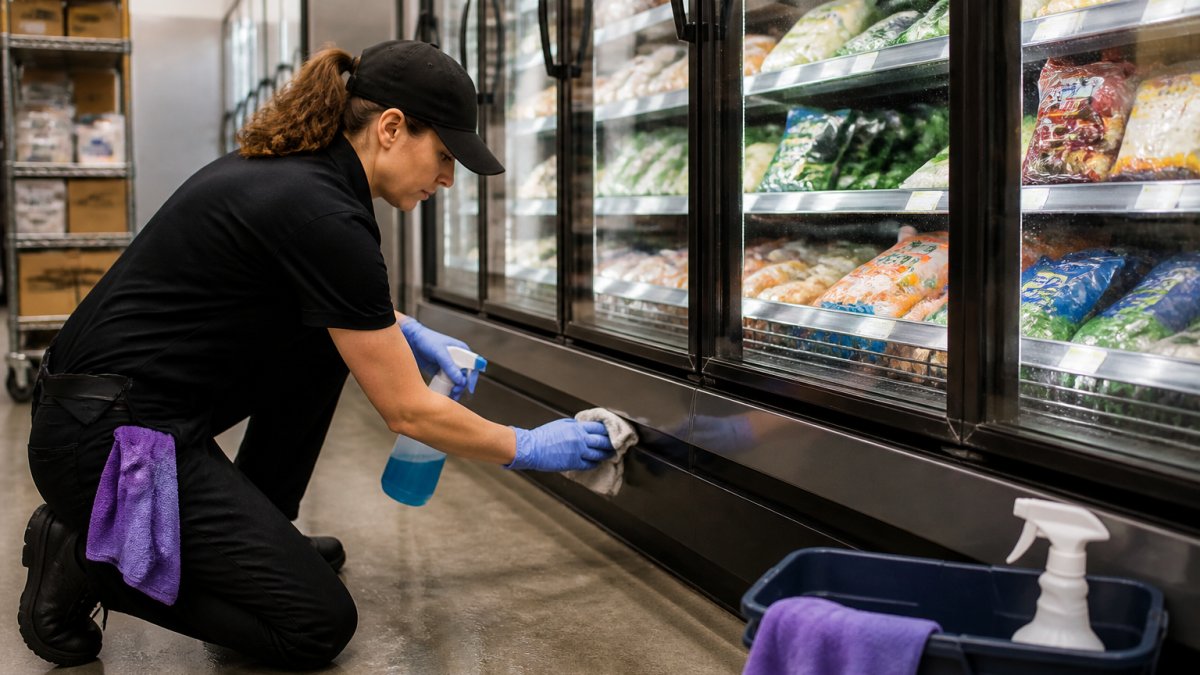
As a CMI certified company, CVG Specialized Cleaning INC brings deep cleaning and disinfecting equipment, eco-friendly products, and emergency disinfecting response to facilities across the region. The company offers a range of services, including nightly office cleaning and specialized supermarket support.
Contact us to schedule a walkthrough and get a scope built around your facility.
Frequently Asked Questions
What is the difference between commercial cleaning and janitorial services?
Janitorial services handle routine, day-to-day cleaning: dusting, mopping, vacuuming, restroom cleaning, and trash removal on a recurring schedule. Commercial cleaning is the broader category and includes those routine tasks plus periodic and heavier work such as deep cleaning, floor care, disinfection, and post-construction cleanup. Many facilities need both, which is why the two terms often overlap in contracts and job descriptions.
How much does office cleaning cost per hour?
Hourly rates vary by region, facility size, and the scope of work, so no single figure applies to every building. What drives your office cleaning estimate is square footage, restroom count, floor types, cleaning frequency, and whether you need specialized disinfection. Ask for a walkthrough-based quote rather than a flat hourly rate, and confirm what labor hours the estimate assumes so you can compare proposals fairly.
How often should a commercial facility be cleaned?
Most offices need daily or several-times-weekly janitorial service for restrooms, trash, and high-touch surfaces, with periodic deep cleaning monthly or quarterly. Healthcare and clinical spaces usually require daily disinfection plus terminal cleaning protocols. Warehouses and industrial buildings with attached offices often split the schedule: nightly office cleaning and less frequent heavy cleaning on the floor. Your commercial cleaning schedule should be set by traffic, occupancy, and compliance requirements.
Can one cleaning company provide both janitorial and specialized cleaning?
Yes, and combining them under one janitorial services contract usually simplifies accountability. A single provider handles nightly office cleaning, restroom sanitation, and floor care, then adds deep disinfecting, electrostatic spraying, or emergency outbreak response when needed. Confirm in writing that the provider has the equipment and certifications for the specialized work, and check the contract's response time commitments for emergency calls.
The difference between a facility that looks clean and one that is actually clean comes down to scope. Get the scope right, put it in a contract, and verify it. CVG Specialized Cleaning INC can help you do all three, with CMI certification behind the work and a full range of services from floor care to emergency disinfecting. Get started with CVG Specialized Cleaning INC and build a cleaning program your facility can rely on.
Comments