


7 Eco Friendly Cleaning for Supermarkets Strategies
Last Updated: October 25, 2026
Quick Summary
Eco friendly cleaning for supermarkets means sanitizing grocery facilities with products and methods that reduce chemical exposure for shoppers, staff, and food on your shelves. It works only when food-safe products, low-water equipment, and a documented zone-by-zone checklist hold together shift after shift.
Check for an EPA registration number, a food contact statement, and the required contact time on every product label.
Sweep or dust mop before any wet cleaning, since wet debris turns into the muddy film customers see.
Autoscrubbers with solution metering apply minimum water and recover it, cutting chemical use.
Assign each zone a task, frequency, and product, and wipe cold case gaskets daily with a food-safe sanitizer.
Never mix a green cleaner with bleach, and wash microfiber pads without fabric softener.
Table of Contents
Why Eco Friendly Cleaning for Supermarkets Changes the Whole Store
Food-Safe Cleaning Products That Pass Inspection
Reading Labels: What to Look For on a Product
Where Eco Cleaners Fall Short and What to Use Instead
Green Cleaning Best Practices for High-Traffic Grocery Floors
Commercial Floor Cleaning Equipment That Cuts Chemical Use
The Supermarket Cleaning Checklist That Keeps Every Zone Covered
High-Risk Zones: Refrigerated Units, Deli Counters, and Produce
Common Mistakes That Undo Your Green Cleaning Program
What to Ask a Cleaning Partner Before You Sign
Request a Walkthrough and Build Your Eco Cleaning Plan
Frequently Asked Questions
Why Eco Friendly Cleaning for Supermarkets Changes the Whole Store
Eco friendly cleaning for supermarkets is the practice of sanitizing grocery facilities with products and methods that reduce chemical exposure for shoppers, staff, and the food on your shelves. It changes more than the smell of the store. It changes what customers breathe as they walk the aisles, what residue sits on produce shelving, and how confidently your team handles a spill near the deli counter.
At CVG Specialized Cleaning INC, we treat green cleaning as an operations decision, not a marketing badge.
The stakes are practical. Grocery environments combine food contact surfaces, high foot traffic, and cold zones that trap moisture and odor. Cleaning choices ripple through all three. Below, we break down the seven strategies that make a green program hold up under real store conditions, and where most programs quietly fall apart.
Food-Safe Cleaning Products That Pass Inspection
Food-safe cleaning products are cleaners and sanitizers formulated to remove soil and reduce pathogens without leaving harmful residue on surfaces that touch food. In a grocery setting, that means products labeled for food contact surfaces, used at the dilution the label states, with the surface allowed to air dry where the instructions require it.
Reading a label properly matters more than the bottle's color scheme. Three things decide whether a product belongs in your program:
EPA registration number. Sanitizers and disinfectants sold with pathogen claims carry one. If it's missing, you're holding a general cleaner, not a sanitizer.
Food contact statement. The label should say the product is acceptable for food contact surfaces, with directions for rinsing or no-rinse use.
Contact time. The surface must stay wet for the stated time (the EPA). A quick wipe and a walk-away is not sanitizing, no matter what the bottle promises.
Reading Labels: What to Look For on a Product
Start with the active ingredient and the signal word. "Caution" signals lower acute toxicity than "Danger." Then check the dilution ratio, because over-concentrating a green product is one of the most common ways stores accidentally undo their own program. Finally, look for third-party certification marks such as Safer Choice, which the EPA's Safer Choice program uses to identify products with safer chemical ingredients.
Where Eco Cleaners Fall Short and What to Use Instead
Green products are not magic. Heavy grease on a rotisserie hood, dried protein on a deli slicer, and mold in a cooler door gasket all need more muscle than a mild citrus degreaser provides. In those spots, use a targeted product with the correct dwell time rather than doubling the dose of a gentle one. Match the product to the soil, not the other way around.
Green Cleaning Best Practices for High-Traffic Grocery Floors
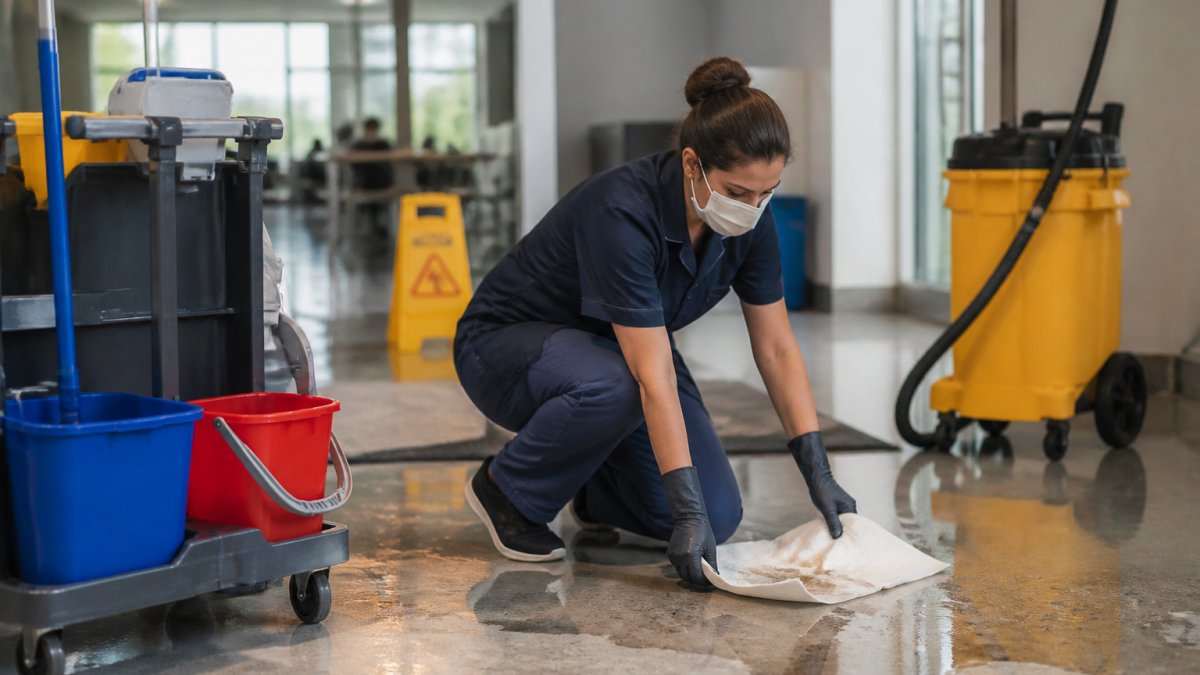
High-traffic grocery floors need a sequence, not a scrub. The order is: dry soil removal first, then damp cleaning, then spot treatment. Skipping the dry pass is the single biggest reason floors look dull within a day of cleaning.
Here are green floor program best practices for a busy store:
Dust mop or sweep before anything wet touches the floor. Debris turns into a muddy film when wet, and that film is what customers see.
Use microfiber flat mops with a two-bucket or pre-soaked system. Microfiber lifts soil with far less water and chemical than string mops.
Clean entryways and produce aisles first. These carry the most tracked-in soil and the most spill risk.
Set a dilution station and lock it. Hand-mixed buckets drift stronger over time, which wastes product and leaves residue.
Watch out: mopping with too much solution leaves a sticky film that attracts dirt and makes the next shift's job harder. Less water, changed more often, beats a wetter mop every time.
Commercial Floor Cleaning Equipment That Cuts Chemical Use
Commercial floor cleaning equipment reduces chemical demand when it meters solution, agitates mechanically, and recovers dirty water. The machine does the work that chemical used to do.
Three categories earn their place in a green program:
Autoscrubbers with solution metering. These apply the minimum water needed and pick it back up, so floors dry faster and chemical use drops.
Microfiber flat mop systems. Lower water volume, better soil pickup, and washable pads that cut disposable waste.
HEPA-filtered vacuums. These capture fine dust instead of pushing it into the air, which matters near open food displays.
The trade-off is real. Equipment costs more up front and needs maintenance. What most reviews miss is that the savings show up in labor and chemical spend over time, not on the invoice. If you are coming from string mops and buckets, expect a short adjustment period while the team learns the new rhythm.
The Supermarket Cleaning Checklist That Keeps Every Zone Covered
A supermarket cleaning checklist is a zone-by-zone schedule that assigns each area a task, a frequency, and a product. The checklist is what turns a green program from an intention into a repeatable routine.

Zone | Task | Frequency | Product Type |
Sales floor | Dust mop, spot clean | Daily | Neutral floor cleaner |
Refrigerated cases | Wipe doors and gaskets | Daily | Food-safe sanitizer |
Deli counters | Clean, sanitize, air dry | After each shift | Food contact sanitizer |
Produce shelving | Remove debris, wipe | Daily | Mild food-safe cleaner |
Restrooms | Full sanitize cycle | Twice daily | EPA-registered disinfectant |
Backroom and receiving | Sweep, spot mop | Daily | Neutral cleaner |
High-Risk Zones: Refrigerated Units, Deli Counters, and Produce
Cold cases, deli counters, and produce areas carry the highest food-safety risk and the most odor potential. Gaskets trap moisture and food particles, so they need a dedicated wipe-down, not a pass with the floor mop. Deli slicers must be broken down and sanitized per the equipment maker's instructions (the FDA). Produce shelving needs a food-safe product with no lingering fragrance that transfers to fruit.
Restrooms deserve their own line on the checklist, and our commercial restroom cleaning service covers the fixtures, touchpoints, and odor control that keep that zone from dragging down the rest of the store.
Common Mistakes That Undo Your Green Cleaning Program
The most common mistake is treating green cleaning as a product swap. Stores buy certified cleaners, keep the same methods, and wonder why nothing improves. Method drives results as much as chemistry.
Here are the failure points we see most:
Over-diluting or over-concentrating. Both break the product's performance. Follow the label.
Skipping dwell time. Sanitizers need the surface wet for the stated time. Rushing defeats the purpose.
Mixing products. Combining a green cleaner with a bleach product can create irritating fumes. Never blend.
No color-coding. One cloth across restrooms and deli counters spreads contamination no product can fix.
Training once and never again. Staff turnover erodes the program within months unless refreshers are scheduled.
A common mistake is buying the cheapest microfiber and washing it with fabric softener. Softener clogs the fibers and kills pickup performance. Wash pads separately, no softener, and retire them when they stop absorbing.
What to Ask a Cleaning Partner Before You Sign
Ask any cleaning partner five questions before signing: what certifications the team holds, how they document zone completion, how they handle food-safety zones, how fast they respond to an outbreak, and how they communicate issues. The answers separate a real program from a crew with mops.
Our team holds CMI certification, and that matters for grocery clients because it reflects formal training in cleaning science rather than on-the-job habit. If you want to see how a partner handles the details, review our janitorial service credentials and our infection prevention approach before you compare proposals.
Insist on documented zone sign-offs. A partner who cannot show you a completed checklist is asking you to trust memory over records. Ask how they handle language and communication gaps too, because missed requests usually trace back to a handoff problem, not a cleaning problem.
Request a Walkthrough and Build Your Eco Cleaning Plan
A walkthrough turns a generic proposal into a plan built around your store's actual zones, traffic patterns, and cold cases. That is the difference between a binder of promises and a schedule your team can run.
Here is how a first visit for an eco cleaning plan is typically structured:
Walk every zone with your facility lead and note soil types and traffic.
Identify food contact surfaces and cold units that need dedicated protocols.
Match products to each zone and set dilution stations.
Build the checklist with frequencies and named owners.
Schedule a review after the first month to adjust.
If you are ready to compare options, get a quote for janitorial services and we will map the scope before you commit. For grocery-specific needs, our supermarket facility cleaning service covers cooler floors, cold case shelving, and the food-safety zones that generic crews miss.
Green cleaning only pays off when the methods, equipment, and documentation hold together shift after shift. That is where CVG Specialized Cleaning INC comes in. As a CMI certified company, we bring eco-friendly products, state-of-the-art deep cleaning and disinfecting equipment, and specialized supermarket support to every account, from cooler floors to deli counters. Get started with CVG Specialized Cleaning INC and build a cleaning program your customers can see and your inspectors can verify.
Frequently Asked Questions
What makes a cleaning product eco-friendly?
A product earns the eco-friendly label when its ingredients break down safely and its packaging or concentrate reduces waste. Look for third-party certifications, biodegradable surfactants, and low volatile organic compound content. Concentrates matter too: shipping less water per bottle cuts transport emissions. That said, eco-friendly does not automatically mean food-safe, so check the label for food-contact approval before using anything near prep surfaces or refrigerated units.
Are green cleaning products safe to use around food?
Only if the product is labeled for food-contact surfaces. Many green cleaners are safe for general floors and walls but not approved for direct food-contact areas like deli slicers or produce tables. Read the label for food-contact language, follow the dwell time, and rinse where the manufacturer requires it. Pairing a food-safe cleaning products list with your supermarket cleaning checklist keeps staff from guessing which bottle goes where.
Do eco-friendly cleaners disinfect as well as conventional products?
Many do, but the result depends on dwell time and surface type rather than the green label alone. Some plant-based disinfectants need a longer wet contact time than quaternary ammonia products. Check the EPA registration and the listed contact time on the label, then train staff to actually wait that long. Skipping the dwell time is the most common reason a green disinfectant underperforms in a busy store.
How can grocery stores reduce water and chemical use during cleaning?
Two changes deliver most of the savings: switch to concentrate dilution systems that meter exact amounts, and use commercial floor cleaning equipment like auto-scrubbers with solution control instead of mop buckets. Auto-scrubbers apply and recover water in one pass, so floors dry faster and less chemical goes down the drain. Add microfiber cloths, which lift soil with less product, and set a dilution station so staff cannot over-pour.
CONTACT US
Add cvgservices.com as a preferred source on Google →

Comments