


Commercial Kitchen Cleaning: A Step-by-Step Procedure
Quick Summary
Commercial kitchen cleaning covers every surface, appliance and drain in a food-service operation that touches food, grease or hands, from prep tables and fryers to hoods and floors. Daily tasks prevent buildup, while weekly, monthly and quarterly work removes what routine cleaning misses. Staff handle routine tasks and specialized professionals handle hood and exhaust work.
Daily tasks prevent buildup; weekly and monthly tasks remove what daily cleaning misses.
Always scrape and pre-clean before applying any sanitizer, since grease shields bacteria.
Hood and exhaust cleaning requires a qualified service and should be recorded with service and due dates.
Test sanitizer concentration at the start of each shift using manufacturer-recommended strips.
Request a written quote scope listing each zone, frequency and documentation method before booking.
Need a commercial kitchen cleaned to standard?
CVG Specialized Cleaning INC provides commercial kitchen and facility cleaning across Connecticut and New England.
Table of Contents
What Commercial Kitchen Cleaning Covers and Who Does It
Commercial kitchen cleaning covers every surface, appliance and drain in a food-service operation that touches food, grease or hands. That includes prep tables, cutting boards, walk-in coolers, fryers, ovens, hoods and floors. Many restaurants split the work between daily line cleaning done by staff and periodic deep cleaning done by a crew or a contractor.
The question of who does what usually comes down to the task's risk and skill level. Staff handle wipe-downs, sanitizing between uses and emptying grease traps. Professionals handle hood and exhaust cleaning, which requires specialized tools and documentation, and deep cleaning of equipment that is difficult to take apart.
Keep the boundary clear in writing. A contractor's scope should list each zone and task, along with how often it is done.
Commercial Kitchen Cleaning Schedule: Daily, Weekly, and Monthly Tasks
A workable schedule matches task frequency to how fast grease, food residue and bacteria build up. Daily tasks prevent buildup. Weekly and monthly tasks remove what daily cleaning misses.
Frequency | Typical tasks | Who usually does it |
Daily | Sanitize food-contact surfaces, clean fryers, wipe hood fronts, mop floors, empty grease traps | Kitchen staff |
Weekly | Clean behind and under equipment, degrease walls, clean walk-in cooler shelving, descale dishwasher | Staff or closing crew |
Monthly | Clean filters, inspect drains, deep-clean refrigerator coils, check ventilation fans | Staff with supervisor review |
Quarterly or as required | Hood and exhaust system cleaning, full equipment disassembly, floor scrubbing and pressure washing | Professional service |
Frequency depends on volume. A high-volume fryer station may need daily grease removal at the end of every shift, while a low-volume bakery may only need weekly attention. Adjust the schedule after your first month and record what you find.
Commercial Kitchen Cleaning Checklist by Zone
A zone checklist works only if it tells staff what order to work in and how to confirm the zone is actually clean. For practical ways to keep these standards steady over time, read commercial cleaning consistency tips.

Cooking line (grill, griddle, fryer, range). Turn off and cool equipment. Scrape the griddle plate with a non-abrasive scraper and push residue into the drip tray.
Prep area (tables, cutting boards, sinks). Clear and scrape boards, then wash with detergent, rinse, and sanitize. Switch or sanitize boards between raw meat and ready-to-eat items.
Cold storage (walk-in cooler and freezer). Check door gaskets for tears and residue, wipe shelves from top to bottom, and pull product forward to clean the shelf underneath. Discard expired product during the pass rather than after.
Dish area. Scrape and rinse wares before loading. Clean the dishwasher drain screen daily, descale the machine on the manufacturer's schedule, and sanitize the dish tables after the final load.
Hood and exhaust. Staff wipe the hood exterior and soak or wash filters on the schedule the hood-cleaning service recommends. Ductwork, fan, and hood interior are cleaned by a qualified service. Record the service date and the next due date on the hood.
Floors and drains. Sweep or vacuum dry debris first, then mop with a detergent solution, then rinse. Clear floor drains and sanitize the drain cover. Keep a dedicated mop and bucket for the kitchen so floor chemicals do not migrate to food-contact surfaces.
Storage and receiving. Keep dry goods at least six inches off the floor, wipe shelving when stock is rotated, and clean the receiving area after each delivery. Check that chemicals are stored below and away from food, not on the same shelf.
Watch out: Working from the floor up, or sanitizing before scraping, is the most common reason a zone fails a spot-check. Grease and food residue shield bacteria from the sanitizer, so the order matters as much as the chemical.
After each zone is cleaned, the person who cleaned it initials the zone log and notes any damage, pest evidence, or equipment problem. To turn this into pass-or-fail checks and a logging system that flags missed tasks early, start with the verification steps below.
Restaurant Kitchen Cleaning Procedures, Step by Step
A consistent procedure matters more than a perfect one. Follow the same order every time so no step gets skipped.
Clear and remove. Take out loose trash, dirty linens and small equipment before you start. Work from the highest surfaces down to the floor.
Scrape and pre-clean. Remove food debris and grease with a scraper and a degreaser. Do this before any sanitizer is applied.
Wash. Apply a detergent solution with a clean cloth or brush. Work from clean areas toward dirty ones.
Rinse. Remove detergent residue with clean water. Leftover soap can affect sanitizer performance.
Sanitize. Apply an approved sanitizer at the correct concentration and let it sit for the contact time listed on the label.
Air dry. Let surfaces air dry rather than wiping them with a towel, which can recontaminate them.
Log the task. Record the zone, the time and the initials of the person who completed it.
Watch out: Skipping the scrape step is the most common cause of poor results. Sanitizer cannot work through a layer of grease.
Hood and Exhaust System Cleaning
The hood and exhaust system collect grease vapor that can ignite if buildup becomes heavy. Hood cleaning frequency under the applicable fire-safety standard depends on how much cooking your kitchen does. Check the current edition of the standard and your local fire marshal's requirements, since many jurisdictions adopt it with local amendments. Keep service records, because inspectors and insurers ask for them.
Hood cleaning is specialized work. Staff should wipe the exterior and filters, but the ductwork, fan and interior should be cleaned by a qualified service. To decide between commercial cleaning and janitorial services, compare what each provider typically covers.
Ovens, Griddles, and Cooking Equipment
Ovens and griddles need cleaning after every shift because residue hardens quickly. Turn off and cool equipment before cleaning. Use a non-abrasive scraper on griddle plates, then a degreaser and a clean cloth. Check the manufacturer's manual before using any chemical on a specific surface, since some finishes are damaged by harsh cleaners.
Commercial Kitchen Deep Cleaning: When and How
Deep cleaning is the work that daily and weekly routines cannot reach: behind and under equipment, inside ventilation components, floor drains, walk-in cooler coils, and the buildup on walls and ceilings above cooking lines. It is also the work most likely to be deferred until an inspection, a pest issue, or an insurance review forces it.
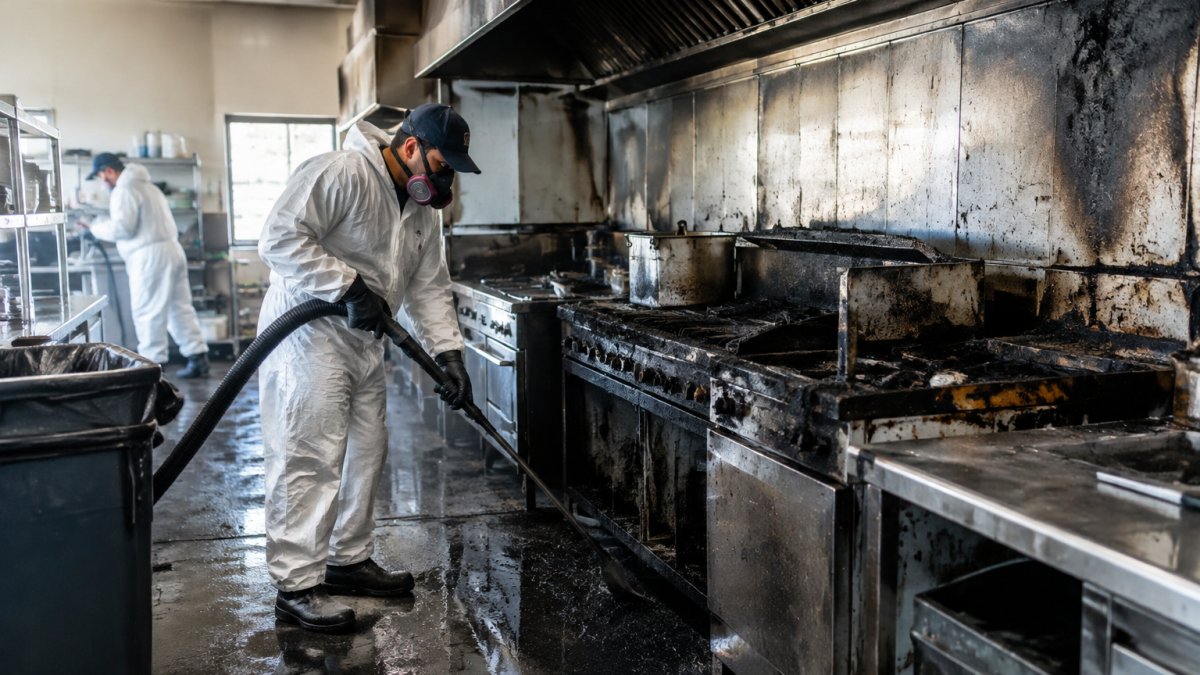
Triggers that justify scheduling a deep clean. A health inspection that flags grease, debris, or sanitation problems; a pest sighting or treatment; a kitchen renovation or equipment replacement; a change in menu or volume that outpaces the current schedule; and a fixed quarterly or semiannual cycle as a baseline. If grease buildup or post-incident conditions go beyond routine cleaning, see fire-damage cleanup guidance for what professional recovery work involves.
Sequence and downtime. Plan the work from the highest surfaces down and from the back of the kitchen toward the exit so cleaned areas are not recontaminated. Deep cleans are commonly scheduled overnight or during a closed window, and their duration depends on buildup and access.
DIY versus professional: how to decide. Staff can handle routine deep-cleaning tasks such as pulling equipment, wiping walls, and descaling dish machines if they have the time, the chemicals, and the training. Outsource the tasks that require specialized tools, confined-space entry, or documentation: hood and duct cleaning, fan and rooftop exhaust work, and heavy grease removal in hard-to-reach areas.
Cost drivers to expect in a quote. Pricing depends on factors such as kitchen size, the scope of work, and the schedule. Contact CVG Specialized Cleaning INC directly for current pricing. Ask for a line-item scope by zone so you can compare quotes on the same tasks rather than on a single lump sum.
Watch out: Booking a deep clean without a written scope that separates hood and duct work from general deep cleaning is the most common cause of a quote that grows after the crew arrives. Confirm what is included, what is excluded, and how completed work will be documented before the date is set.
Chemical Selection, Dilution, and Safe Storage
Choose chemicals that are labeled for food-contact surfaces and that the manufacturer lists for the job. Look for the EPA registration number on the label (the EPA).
Follow the dilution ratio exactly. Too weak and the sanitizer will not kill bacteria. Too strong and it can leave residue or damage surfaces. Test sanitizer concentration with the test strips recommended by the manufacturer.
Store chemicals in their original containers, away from food and prep areas. Keep the Safety Data Sheet for each product where staff can find it. Never mix chemicals, because some combinations release toxic gases.
Verifying Results and Keeping Cleaning Records
A clean-looking kitchen is not always a sanitized one. Verify results with checks that someone other than the cleaner can perform.
Test sanitizer concentration at the start of each shift.
Do a visual spot-check of three to five random zones each day.
Keep a written log of completed tasks with dates, initials and any problems found.
Review the log weekly and address repeated misses with retraining or a schedule change.
Records protect you during inspections and insurance claims. They also show whether your schedule matches the work the kitchen actually needs.
Booking Professional Commercial Kitchen Cleaning with CVG
Some tasks, such as hood and exhaust cleaning and full deep cleaning, are better handled by a professional service. When you request a quote, ask for a written scope that lists each zone, frequency, the chemicals used and how completed work is documented.
CVG Specialized Cleaning INC provides commercial cleaning, sanitizing and deep disinfecting services for facilities in Connecticut and New England. Pricing depends on the size of the kitchen, the scope of work and the schedule, so contact CVG Specialized Cleaning INC directly for a quote tailored to your operation. Get a quote for janitorial services to see what information to prepare before you call.
Frequently Asked Questions
How often should a commercial kitchen be deep cleaned?
Most commercial kitchens need a full deep clean on a monthly or quarterly basis, with hood and exhaust cleaning scheduled according to the applicable fire-safety standard based on cooking volume and type. High-volume operations that fry or grill heavily often need more frequent service. Daily and weekly tasks should continue between deep cleans. Your local fire marshal and insurance carrier may also set minimum intervals, so confirm those requirements before setting your schedule.
What should be included in a commercial kitchen cleaning checklist?
A commercial kitchen cleaning checklist should list every zone and task by frequency: daily wiping of prep surfaces and sanitizing food-contact areas, weekly degreasing of fryers and hood filters, and monthly cleaning of ovens, walk-in cooler shelving, and floor drains. Each line should name the chemical, dilution ratio, contact time, and the person responsible. Initial and date each completed task so the checklist doubles as a verification record.
Which surfaces in a commercial kitchen need to be cleaned and sanitized?
Food-contact surfaces such as cutting boards, prep tables, slicers, and utensils must be cleaned and sanitized before each use and at the end of every shift. Non-food-contact surfaces, including walls, hood exteriors, equipment housings, and floors, need regular cleaning to prevent grease buildup and pest activity. Handles, faucets, and door pulls are high-touch points that should be sanitized at least daily.
How do you create a commercial kitchen cleaning schedule?
Start by listing every area and piece of equipment, then assign each a frequency based on how much it is used and how quickly it soils. Group tasks into daily, weekly, monthly, and periodic categories, and assign an owner to each. Post the schedule where staff work and review it after every inspection or health department visit. Adjust frequencies when menu, volume, or equipment changes.
Comments