


Are Eco-Friendly Commercial Cleaning Services Worth It?
Last Updated: October 26, 2026
Quick Summary
Eco-friendly commercial cleaning protects occupant health and reduces environmental impact by replacing harsh chemicals with certified low-toxicity products, microfiber systems, and HEPA filter vacuums. The benefits reach beyond the product list, touching indoor air quality, waste volume, chemical spend, and sick-day rates. Green cleaning works as a system, so the savings show up in places a product swap never touches.
Concentrated formulas cut packaging and shipping weight, and dilution control keeps chemical discharge proportional to the soil removed.
Reusable microfiber survives hundreds of wash cycles when laundered correctly, replacing disposable paper in many applications.
Track four KPIs: chemical concentrate per square foot, waste volume or weight, water use, and occupant feedback on air quality.
Switch products in phases, starting with general-purpose and glass cleaners, so staff adjust and problems surface early.
Green products often need proper dwell time, and rushing contact time is the most common reason a program underperforms.
Table of Contents
Why Eco-Friendly Commercial Cleaning Pays Off for Facilities
Health and Safety Benefits for Staff, Occupants, and Cleaning Teams
Environmental Impact: Lower Emissions, Less Waste, and Resource Conservation
The Cost and ROI Case for Green Cleaning
How to Implement Eco-Friendly Cleaning Practices in Your Facility
Choosing Eco-Friendly Commercial Cleaning Products and Verifying Claims
An Eco-Friendly Cleaning Checklist for Businesses
Building a Green Cleaning Program with CVG Specialized Cleaning INC
Frequently Asked Questions
Why Eco-Friendly Commercial Cleaning Pays Off for Facilities
Eco-friendly commercial cleaning is a janitorial approach that replaces harsh chemical agents with certified low-toxicity products, microfiber systems, and equipment like HEPA filter vacuums to protect occupant health and reduce environmental impact. The benefits of eco friendly commercial cleaning reach further than most facility managers expect, touching everything from sick-day rates to the way a building smells when a patient walks through the door.
Here is the part most guides get wrong: green cleaning is not a product swap. It is a system, and the savings show up in places a product list never touches.
Below, we break down the health, environmental, and financial case, then show exactly how to put it to work in your building.
Health and Safety Benefits for Staff, Occupants, and Cleaning Teams
The strongest argument for green cleaning is human, not environmental. Conventional cleaning chemicals can release volatile organic compounds that irritate airways, and the people most exposed are often the ones holding the spray bottle.
A common mistake is assuming "it smells clean" means "it is clean." Strong fragrance is a chemical signature, not a hygiene result.
Green cleaning flips the priorities:
Lower chemical exposure for janitorial staff through reduced-toxicity products and proper dilution
Better indoor air quality for occupants, since low-VOC products leave fewer indoor air pollutants behind
Fewer respiratory issues for employees and, in healthcare settings, for patients with compromised immune systems
Safer workplace outcomes overall, because teams handle gentler products with less protective gear friction
For clinical and rehabilitation facilities, this matters beyond comfort. Reducing chemical exposure supports infection control goals without adding irritants to already vulnerable populations. The EPA's Safer Choice program certifies products that meet its safety and performance standards, which gives facility managers a starting point for procurement.
Environmental Impact: Lower Emissions, Less Waste, and Resource Conservation
The environmental case rests on three levers: what goes down the drain, what gets thrown away, and what gets consumed. Green cleaning addresses all three at once, and each lever can be measured rather than asserted.
What goes down the drain. Biodegradable products break down after use, so fewer hazardous compounds reach waterways.
What gets thrown away. Microfiber cloths and mops replace disposable paper in many applications, and reusable microfiber survives hundreds of wash cycles when laundered correctly. Concentrated products cut packaging waste at the source.
What gets consumed. Microfiber cleans effectively with less liquid, so water use per task drops. HEPA filter vacuums capture fine particles that standard vacuums recirculate into the air, which improves indoor-air indicators without adding chemical load.
The broader payoff is a smaller carbon footprint across the operation, from fewer deliveries of heavy pre-mixed products to less energy spent on waste handling.
Pro Tip Report the impact with four practical KPIs: chemical concentrate purchased per square foot, waste volume or weight per month, water use where metered, and occupant feedback on air quality and odors. A quarterly trend line on those four numbers is more credible to leadership than any certification logo.
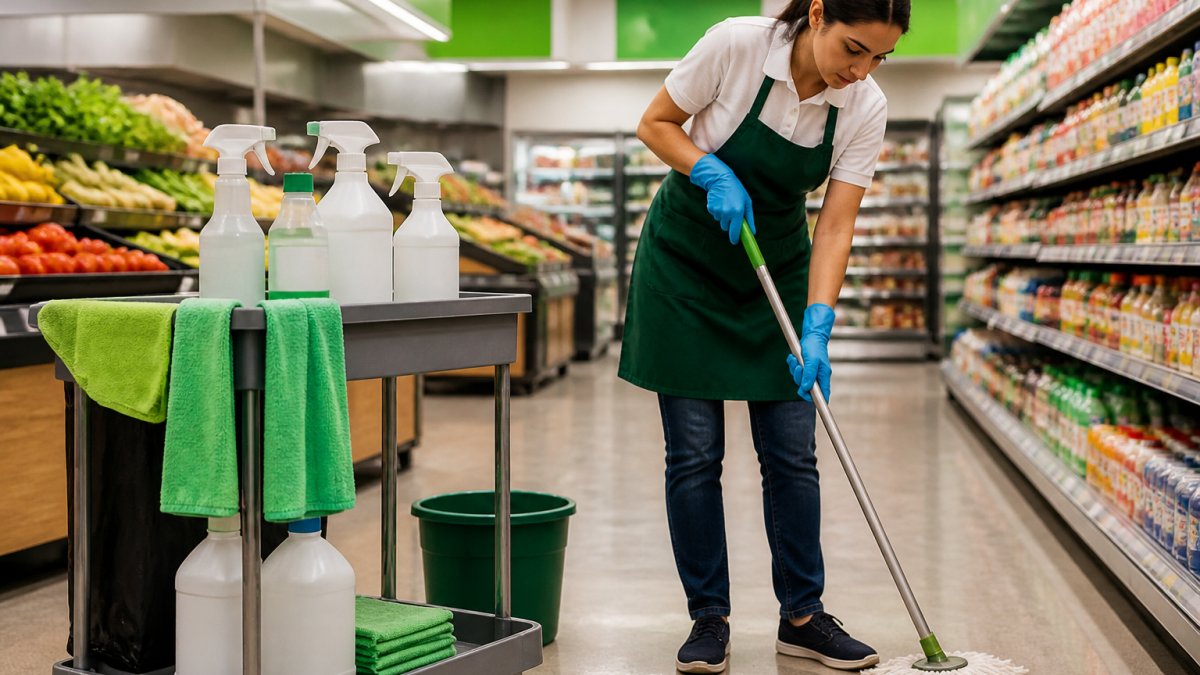
Facility type changes the emphasis. Offices see the largest gains from waste and packaging reduction; healthcare and rehabilitation settings weight indoor-air and chemical-load indicators more heavily because vulnerable populations raise the stakes; food-service and supermarket zones prioritize biodegradable products and dilution discipline for food-safety reasons. Match the metric to the risk, and the environmental case becomes a management tool rather than a slogan.
The Cost and ROI Case for Green Cleaning
Does green cleaning cost more? Sometimes the products do carry a higher sticker price. The total cost of ownership tells a different story, and that is where the ROI case lives.
Here is what most quotes miss. The savings from eco-friendly cleaning rarely appear on the invoice. They show up in five cost lines that a conventional program never itemizes:
Chemical spend. Concentrated products are diluted on site, so you buy water at the tap instead of paying to ship it. A facility that switches from ready-to-use to concentrate typically cuts per-gallon chemical cost substantially, and a dilution control system prevents the over-pouring that erases the gain.
Waste hauling. Fewer jugs, less packaging, and reusable microfiber reduce the volume and weight going to the dumpster. Waste hauling is billed by volume or weight, so the reduction is visible on the invoice.
Labor and absenteeism. Indoor air quality and reduced chemical irritation are linked to fewer sick days and fewer odor complaints. Track sick-day rates and complaint logs before and after the switch; the delta is the labor saving.
Surface and floor life. Gentler, correctly diluted products and microfiber rather than abrasive pads slow wear on finishes. Resurfacing and refinishing intervals stretch, and that is a capital cost avoided.
Liability and compliance. Fewer hazardous compounds on site means less storage, handling, and disposal exposure. That lowers training burden and insurance friction even when no claim is ever filed.
A transparent way to frame the comparison is a simple total-cost worksheet. List chemical spend per month, waste hauling per month, paper and disposable spend per month, and sick-day cost per month for the current program. Then list the same lines for the proposed green program, including any product premium. Most find the premium is a small fraction of the combined savings once dilution, waste, and absenteeism are counted, but only if the numbers are actually tracked.
Watch Out The catch is measurement. Facilities that never log chemical usage, waste volume, or sick-day trends will never see the return, even when it is there. Build the tracking into the contract from day one, not after the first renewal.
Pricing for a green janitorial program depends on square footage, facility type, and service frequency, so a single national figure would be misleading. Ask any vendor to break the quote into product, labor, equipment, and waste lines so you can compare total cost of ownership rather than sticker price. For a clearer picture of how quotes are structured, see this guide to getting a quote for janitorial services.
How to Implement Eco-Friendly Cleaning Practices in Your Facility
Implementation follows a sequence, and skipping steps is where most programs stall.

Step 2: Set priorities by risk. High-traffic restrooms, food zones, and patient areas come first.
Step 3: Switch products in phases. Replace one category at a time, starting with general-purpose cleaners and glass cleaners.
Step 4: Train on dilution and dwell time. Green products often need proper dwell time to work.
Step 5: Standardize equipment. Color-coded microfiber, HEPA filter vacuums, and no-touch equipment reduce cross-contamination and chemical waste together.
Step 6: Measure and report. Track chemical usage, waste volume, and occupant feedback monthly.
If you would rather hand the program to a team that already runs it, explore the specialized cleaning services that cover electrostatic spraying, deep floor care, and no-touch equipment.
Here is the sequence we would follow to roll out a green cleaning program without stalling.
Step | What to do |
Step 1 | Audit every chemical, paper product, and equipment item |
Step 2 | Set priorities by risk: restrooms, food zones, patient areas |
Step 3 | Switch products in phases, one category at a time |
Step 4 | Train on dilution and dwell time |
Step 5 | Standardize equipment: color-coded microfiber, HEPA vacuums, no-touch |
Step 6 | Measure and report chemical usage, waste, occupant feedback monthly |
Choosing Eco-Friendly Commercial Cleaning Products and Verifying Claims
"Green" on a label is a marketing word until someone verifies it. Facilities that buy on packaging alone get burned, and the credibility of the whole program suffers.
Use certification as your filter. Third-party programs like the EPA's Safer Choice label require ingredient review and performance testing, and the EPA's guidance on green cleaning explains how the certification works.
Then read the safety data sheet. Every product should have one, and it tells you what hazards the product actually carries, not what the front label implies.
Watch out: a product can be biodegradable and still be an irritant in concentrated form. Certification covers the formulated product as used, so dilution discipline matters as much as the label.
For sector-specific product guidance, this breakdown of eco friendly cleaning for supermarkets strategies covers food-safety zones and refrigerated units where product choice carries extra weight.
An Eco-Friendly Cleaning Checklist for Businesses
Use this checklist to assess where your facility stands today. Any unchecked box is a place to start.
Every cleaning product has a current safety data sheet on file
At least one product line carries a recognized third-party green certification
Dilution control is in place for concentrated products
Microfiber cloths and mops are color-coded by zone
Vacuums use HEPA filtration
Restrooms are cleaned with no-touch equipment where possible
Paper and packaging waste volume is tracked monthly
Staff have documented training on dwell time and dilution
Occupant feedback on air quality and odors is collected
Chemical usage is reviewed against the previous quarter
Run the checklist quarterly. Programs drift, and a quarterly review catches drift before it becomes a complaint.
Building a Green Cleaning Program with CVG Specialized Cleaning INC
A green cleaning program only works if the team executing it understands the products, the equipment, and the facility. That is the gap most in-house efforts fall into: good intentions, inconsistent execution.
CVG Specialized Cleaning INC is a CMI certified cleaning company, and that certification means our team is trained on the methods and standards that make green cleaning perform. Learn why CVG Specialized Cleaning is the new standard for infection prevention.
To see what a program looks like for your building, review our infection prevention and deep cleaning services.
Green cleaning fails when it is treated as a purchasing decision instead of an operating discipline.
Frequently Asked Questions
Are eco-friendly commercial cleaning products as effective as traditional chemicals?
In most commercial settings, yes. Modern green products rely on plant-based surfactants, enzymes, and microfiber tools that lift dirt and grime effectively. The key difference is dwell time: eco-friendly products often need 30 to 60 seconds of contact to work, so your crew should follow label instructions. For high-risk areas like clinical spaces, pair green products with proven disinfectants and a structured protocol. A CMI-certified provider can match the right product to each surface and pathogen risk.
How do I verify that a cleaning company's green claims are legitimate?
Ask for the product list and check for third-party certifications such as Safer Choice, Green Seal, or UL ECOLOGO on each concentrate. Request safety data sheets and confirm the provider trains staff on dilution ratios, since over-concentrating wastes product and increases chemical exposure. Ask how they measure results, such as ATP testing or inspection scores. A provider that cannot show documentation is asking you to take its word, which is not verification.
Can eco-friendly cleaning improve indoor air quality in a commercial building?
It can reduce one major source of indoor air pollutants: volatile organic compounds from conventional cleaners. Pair low-VOC products with HEPA filter vacuums to capture fine particles and dust that otherwise stay airborne. The combined effect matters most in occupied spaces like medical offices, schools, and rehabilitation centers where staff and patients spend long hours. Ventilation and HVAC maintenance still play a role, so treat green cleaning as one part of a broader air quality plan.
What should an eco-friendly cleaning checklist for businesses include?
A workable checklist covers daily, weekly, and monthly tasks. Daily items include high-touch disinfection, restroom sanitation with color-coded microfiber, and trash and recycling removal. Weekly items include floor care, filter vacuuming of carpets, and restocking with diluted concentrates. Monthly items include equipment cleaning, dilution station audits, and a review of waste diversion rates. Add a sign-off column per zone so facility managers can confirm each task was completed and spot missed areas quickly.
CONTACT US
Add cvgservices.com as a preferred source on Google →

Comments